Die casting is a permanent-mould foundry process in which a molten metal is injected at high pressure into a steel mould. It is used for low-melting-point non-ferrous alloys such as aluminium, Zamak and brass, and produces precise, repeatable components with a good finish. The quality of the casting depends directly on the quality of the mould.
Die casting, explained by the people who build the moulds
Die casting is the technique used to mass-produce precision metal components, from car parts to handles, by injecting molten metal at high pressure into a mould. It is the metal-world equivalent of what injection moulding is for plastics.
On this page we explain how it works, the differences between hot chamber and cold chamber and the metals involved. We do so from a specific standpoint: at FPM we do not melt the metal, but for over 40 years we have designed and built the die-casting moulds for aluminium, Zamak and brass, at our site in Lodrino, in the province of Brescia, with ISO 9001:2015 certified quality. And a good casting, above all, comes from a good mould.
What die casting is
Die casting is a casting process in which a liquid non-ferrous metal is injected at high pressure into the mould, also called the die or form. The metal rapidly fills every detail of the cavity, cools and solidifies taking the shape of the part, which is then ejected. The resulting component is called a casting or die-cast part.
Compared with other casting methods, it is precisely the high pressure that makes the difference: it ensures complete filling even of the thinnest and most complex geometries, a good surface finish and tight tolerances, with little or no subsequent machining. This is why it is the typical choice when many identical, lightweight and well-finished metal parts are needed. The mould, in this scheme, is the permanent tooling reused for thousands or millions of shots: this is where FPM’s work comes in.
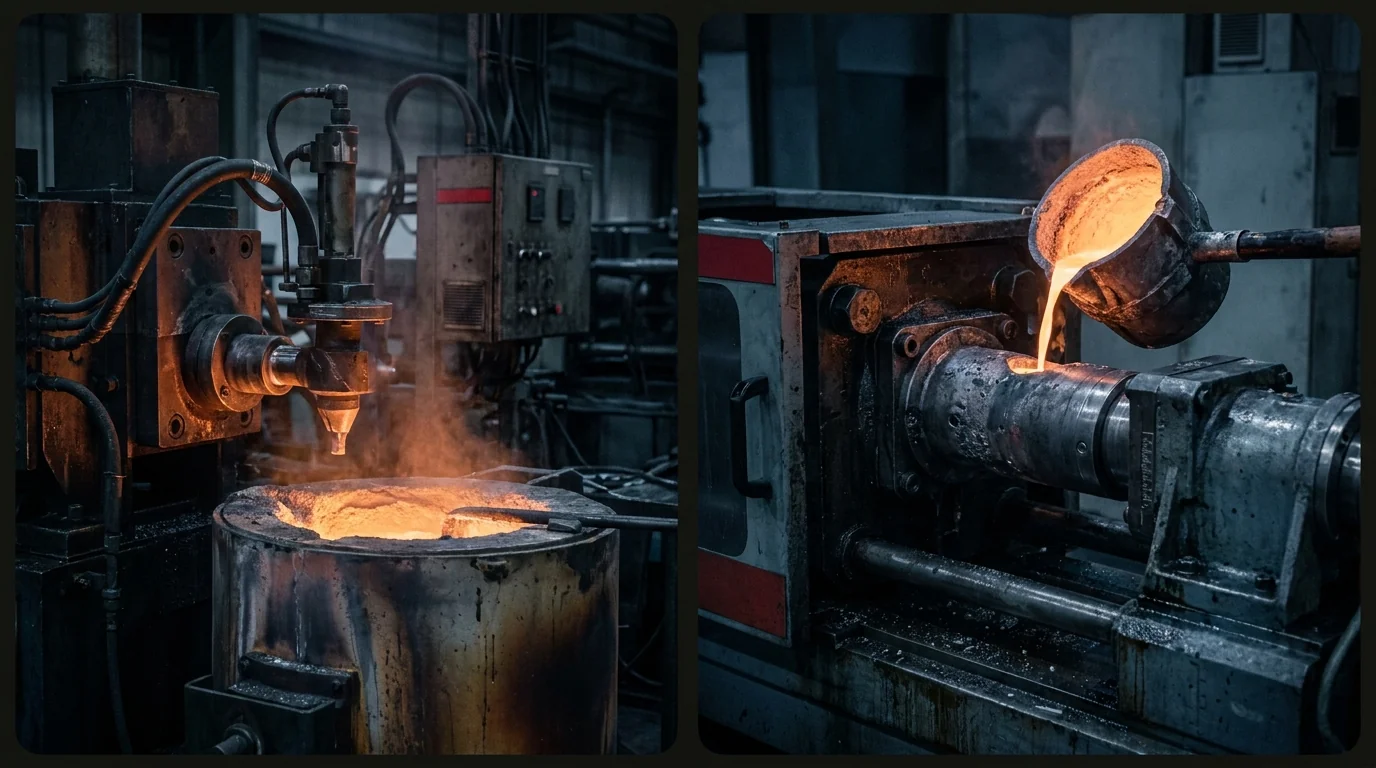
How the process works, step by step
The die-casting cycle resembles that of plastic injection moulding, but with liquid metal and much higher pressures. It always takes place in the same stages, repeated shot after shot.
01 Mould closing
The two mould halves are clamped with a strong clamping force, expressed in tonnes, which must withstand the thrust of the metal during injection.
02 Injection
The molten metal is pushed by a piston into the cavity at high speed and very high pressure, until it fills every detail.
03 Holding and solidification
Pressure stays applied while the metal cools and solidifies, to compensate for shrinkage and keep the casting sound.
04 Opening and ejection
The mould opens and the ejectors release the casting. The sprue and flash are removed, then the cycle restarts.
The pressures involved are very high. For aluminium they exceed 10,000 psi, about 70,000 KPa, values that drive the metal into every corner of the mould and give the part its precision. Cast-in metal inserts are often integrated into the casting as well, placed in the mould and embedded during the shot, for example bushings, pins or threads.
Hot chamber and cold chamber
There are two variants of the process, chosen according to the metal to be cast. What changes is the point at which the metal is metered and injected, and consequently the working pressure and the mould design.
In hot chamber die casting the injection system is immersed in the molten metal: the piston draws directly from the furnace and injects. It is fast and efficient, with quick cycles, but suitable only for low-melting-point alloys such as Zamak. Working pressures are lower, generally between 2 and 15 MPa.
In cold chamber die casting the metal is metered each time into a separate chamber and then injected by the piston. It is the only option for alloys with a higher melting temperature, such as aluminium, which would ruin a hot-chamber system immersed in the bath. Pressures are much higher, generally between 15 and 150 MPa.
| Feature | Hot chamber | Cold chamber |
|---|---|---|
Injection | system immersed in the molten metal | metal metered in a separate chamber |
Typical metals | Zamak, zinc alloys, magnesium | aluminium, brass, high-melting alloys |
Working pressure | about 2-15 MPa | about 15-150 MPa |
Cycle speed | high | lower |
Mould stress | lower | thermal shocks and high pressures |
The choice between the two is no small detail: it changes the mould design, the steels it is built from and the treatments it will have to withstand. It is one of the first aspects we assess when you bring us a die-casting project.
| Metal | Chamber | Indicative melting point | Characteristics | Typical uses |
|---|---|---|---|---|
Aluminium | cold | about 660 °C | lightweight, strong, good conductivity | automotive, lighting, mechanical engineering |
Zamak (zinc alloy) | hot (sometimes cold) | about 380-420 °C | precision, fine finish, fine details | locks, fashion accessories, handles |
Magnesium | hot or cold | about 650 °C | the lightest of the structural metals | electronics, lightweight parts |
Brass | cold | about 900-940 °C | robust, corrosion-resistant | taps and fittings |
Aluminium die casting is the most widespread: it produces lightweight, strong parts with good conductivity, used in automotive, lighting and mechanical engineering. Because of its high melting point it is worked in cold chamber, with moulds designed to withstand significant thermal shocks.
Zamak die casting, a zinc alloy with aluminium, magnesium and copper (also known as zamak), lends itself to precise, good-looking parts such as lock components, fashion accessories, handles and giftware. It melts at lower temperatures and is worked mainly in hot chamber, although cold chamber is used in some cases. It differs from pure zinc precisely because of the alloying elements, which make it stronger and more stable while remaining just as easy to cast.
Brass is chosen where robustness and corrosion resistance are needed, as in taps and fittings, while magnesium is the lightest of the structural metals and finds a place where weight really matters. FPM builds moulds for die casting these non-ferrous metals, calibrating steels and treatments to the metal to be cast and the volumes.
Benefits of die casting and the difference from gravity casting
The reason die casting is so widely used lies in the balance between quality and volume. Once the mould is ready, every casting comes out with the same precision, a good surface finish and thin walls that are hard to achieve with other casting methods, all at a low cost per part on large numbers. The components are lightweight and strong, and often ready to use with little or no machining.
The difference from gravity casting, in which the metal flows into the mould under its own weight alone, is precisely the pressure: in die casting the metal is forced in, so it fills the details better, gives tighter tolerances and faster cycles. Gravity casting and sand casting remain valid for simpler parts, for very thick geometries or for small runs, where the investment in a die-casting mould is not justified.
In short, die casting pays off when high volumes, precision and repeatability are needed. It is the same criterion as plastic injection moulding: the tooling costs, but it pays for itself on the numbers.
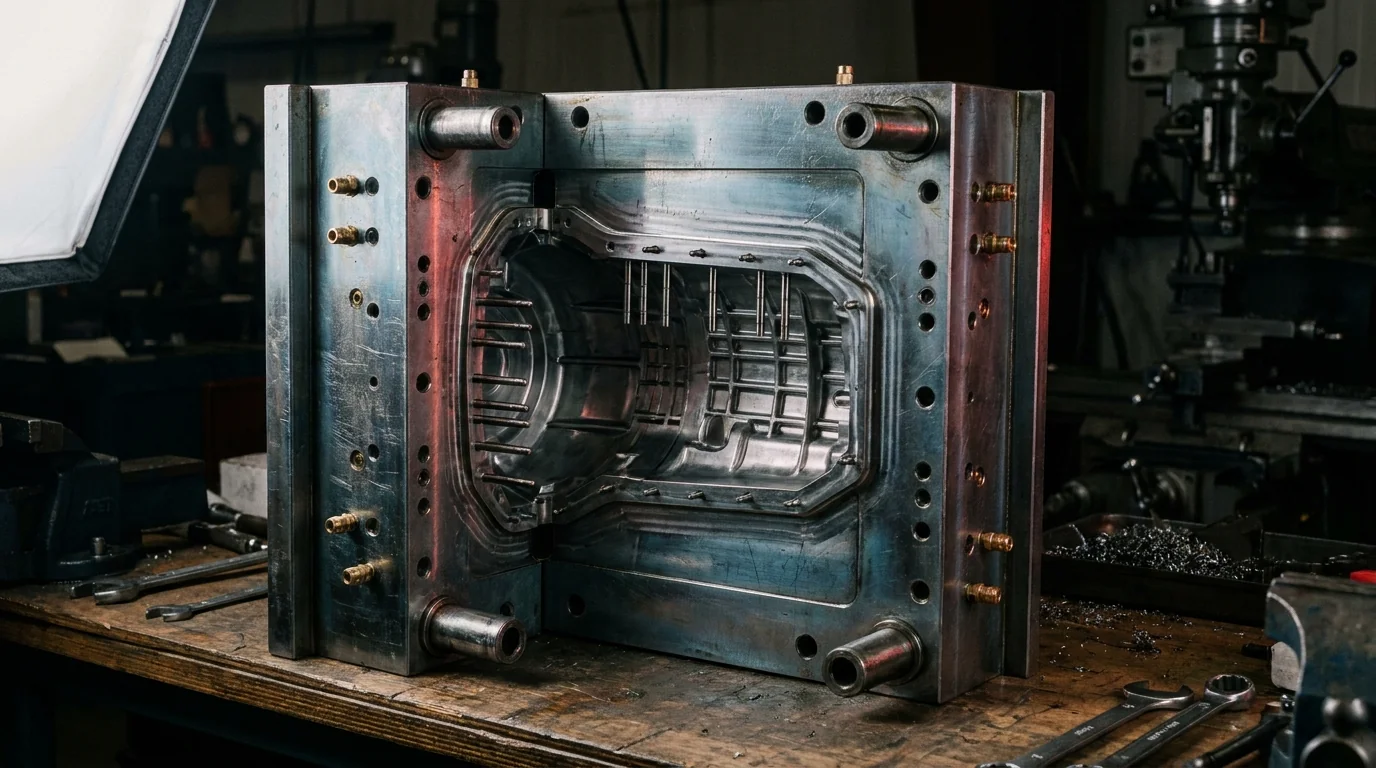
The die-casting mould: this is where the quality of the casting is decided
A precise casting, batch after batch, depends above all on the die-casting mould. It must withstand the entry of the molten metal at high pressure and the continuous thermal shocks without deforming, with carefully designed cooling and an ejection that does not damage the part. It is built from hot-work tool steel and is made of two mould halves, a fixed and a moving part, with cavities, runners, cooling system and ejectors.
The difference between hot chamber and cold chamber is felt precisely in the mould: different pressures and temperatures require different steels, treatments and cooling geometries. It is a job where experience counts enormously, because a wrong detail in the mould is repeated on every single casting.
This is exactly what we have done for over 40 years: we design and build the die-casting moulds for aluminium, Zamak and brass, hot and cold chamber, with cast-in inserts when needed. If you have a die-casting project, we start from the casting you want to obtain and build the right mould to produce it.
Do you have a die-casting project? We build the right mould for your casting.
Frequently asked questions about die casting
How does die casting work?
A non-ferrous metal is melted and injected at high pressure into a mould, where it fills the cavity, cools and solidifies taking the shape of the part. Once the casting is solid the mould opens and the component is ejected, then the cycle starts again.
What does die casting mean?
It is the pressurised casting of non-ferrous metals: the liquid metal does not flow in under gravity, but is forced into the mould. The resulting part is called a casting or die-cast component.
What is the difference between gravity casting and die casting?
In gravity casting the metal fills the mould under its own weight; in die casting it is injected at high pressure. Die casting gives tighter tolerances, thinner walls and faster cycles, and is preferred on large volumes.
What is the difference between hot chamber and cold chamber?
In hot chamber the injection system is immersed in the molten metal and works at lower pressures, suited to low-melting alloys such as Zamak. In cold chamber the metal is metered separately and injected at much higher pressures, needed for alloys such as aluminium.
What is Zamak and how does it differ from zinc?
Zamak is a zinc alloy with aluminium, magnesium and copper. Compared with pure zinc it is stronger and more stable, and melts at low temperatures: this is why it lends itself to hot-chamber die casting of precision parts.
Which metals can be die cast?
Mostly non-ferrous metals: aluminium (cold chamber), Zamak, magnesium and brass. FPM builds moulds for die casting aluminium, Zamak and brass.
Why is the mould so important in die casting?
Because the mould is the permanent tooling that shapes every casting: its precision, cooling and resistance to thermal shocks determine the quality of the part, batch after batch. A defect in the mould is repeated across the whole production run.