A plastic injection mould is the precision tooling, in steel or aluminium, that shapes the molten polymer injected into it: the cavity reproduces the finished part in negative. It is made up of a fixed half and a moving half and integrates the feed system (sprue, hot or cold runner), the injection, the cooling and the ejectors. Building it follows a precise path: feasibility study, co-design, design, construction, trial and fine-tuning. FPM has designed and built moulds in-house for over 40 years, ISO 9001:2015 certified, in Lodrino, in the province of Brescia.
Custom plastic injection moulds, made in-house for over 40 years
Do you have a plastic component to bring into production and need a mould that truly works, with no nasty surprises at the first trial? FPM has been building custom plastic injection moulds for over 40 years, handling every stage in-house: from your initial idea through to a tested mould ready to run.
Why entrust the making of your mould to FPM
A plastic injection mould is an investment that will work for years and, if it is well made, will save you money on every moulding cycle. That is why we don’t treat it as just another job: we design and build it thinking about how it will behave on your press, batch after batch, and how much it will cost you to maintain over time.
When you entrust a project to us you don’t just buy a tool: you take home a mould designed to last, repeatable and with tolerances under control. Here is what changes for you:
- A single point of contact for the whole cycle. Co-design, design, mould construction, trial and maintenance are all handled under one roof. Fewer hand-offs, fewer errors, shorter lead times.
- Over 40 years of moulds behind us, for plastics and die-casting. We know where problems come from and we anticipate them right at the design stage.
- Quality checked at every stage, with ISO 9001:2015 certification and Hasco and Meusburger standard components.
- We don’t leave you halfway. From the mould, if you wish, we move on to plastic injection moulding, assembly, pad printing and finishing, right through to the finished production part.
Having design, construction and moulding in the same company is not an organisational detail: the person who designs the mould talks every day with the person who builds it and the person who runs it in production. If something needs correcting at the trial stage, we solve it in-house, without passing responsibility between different suppliers and without stretching lead times. It is the reason why many customers, after the first mould, entrust the following ones to us as well.
Want to find out whether we are the right mould maker for your project? Tell us about your mould.
What a plastic injection mould is
A plastic injection mould is the tool in which the molten polymer is injected, held under pressure and cooled until the finished part is obtained. From the outside it looks like a simple block of steel, but inside it several systems work together: the cavity that shapes the part, the feed system that carries the material where it is needed, the cooling that governs its solidification and the ejection that releases the component at the end of the cycle.
The mould is mounted on an injection press and stays closed while the material enters under high pressure. The fixed half is clamped to the platen on the injection side; the moving half opens and closes on every cycle. This opening and closing, repeated even thousands of times a day, is what really puts the mould to the test: it must always return the same part, with the same dimensions and the same finish, from the first to the last batch.
To understand what makes a good mould you need to look at the process it will have to withstand. In injection moulding the thermoplastic polymer granules are heated until they become fluid, then injected into the mould, where they fill the cavity, cool, solidify and are ejected. We cover the transformation process itself on the page dedicated to plastic injection moulding; here we stay on the mould.
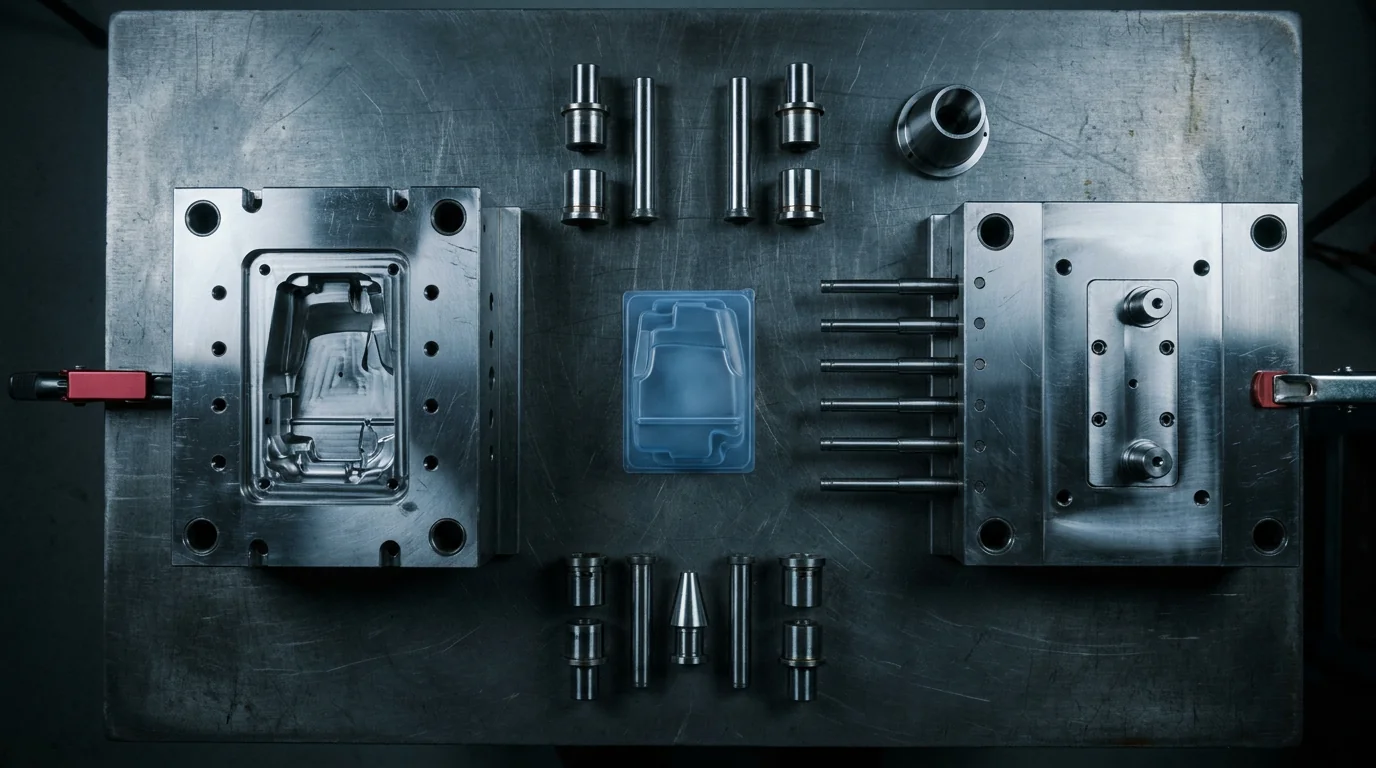
Anatomy of a mould: the components and what they do
Every component of a mould has a precise job, and the care with which it is designed and machined determines the precision, finish and life of the tool. These are the main elements.
- Cavity (female). The recess that reproduces the external shape of the part in negative. It is usually in the fixed half of the mould.
- Core (male). Shapes the inside of the part and sits in the moving half. Cavity and core, mated together, define the wall thickness.
- Fixed half and moving half. The two halves of the mould. The fixed one stays clamped to the platen on the injection side; the moving one opens to release the part. The plane where they meet is the parting line.
- Feed system. The path that carries the molten material from the press nozzle to the cavity: sprue, runners and gates. It can be a cold runner or a hot runner (hot half).
- Gate. The opening through which the material enters the impression. Its position decides how the cavity fills and where the weld lines fall.
- Cooling system (thermal regulation). The channels, usually water-fed, machined into the mould to dissipate heat evenly and control the cycle time.
- Ejection system. Ejector pins, sleeves and plates that push the part out when the mould opens.
- Vents (gas relief). Small reliefs that let the air escape during filling and prevent burn marks and short shots.
- Draft angles. The tapers given to the walls so the part releases without scoring during ejection.
- Plates and mould base. The frame that supports and aligns all the elements and withstands the pressure of the material.
Machining each of these elements to tight tolerances, and making them work together, is the true craft of the mould maker. Poorly distributed cooling or a gate in the wrong place are paid for on every part produced.
Hot runner or cold runner: how to choose
The feed system is one of the choices that weigh most on the cost of the part. In a cold runner mould the material solidifies in the runners too on every cycle: the sprue has to be removed and reconditioned. It costs less to build and maintain, and it is the most sensible choice for limited volumes. In a hot runner mould (hot half) the channels stay heated and the material stays fluid right up to the impression: you eliminate sprue waste, improve the gate and shorten the cycle time, in exchange for a higher initial investment and more maintenance. During co-design we choose the most cost-effective option with you, based on material, geometry and volumes.
| Cold runner | Hot runner (hot half) | |
|---|---|---|
Sprue | solidifies and must be removed on every cycle | none, the material stays molten |
Material waste | present, to be recovered | reduced to a minimum |
Build cost | lower | higher |
Maintenance | simple | more demanding (heated zones) |
Cycle time | longer | shorter |
Ideal volumes | low and medium | medium and high |
Steel or aluminium: the mould materials
Choosing the material we build the mould from is not a technicality that concerns only us: it decides how long the tool will last, how often you will have to stop it for maintenance and how much the first supply will cost you. We calibrate it on the material to be moulded and the production volumes.
- Aluminium has excellent thermal conductivity and is quick to machine: weighing about a third of steel, it is the choice for pilot moulds and very small series, where getting to the real part fast while keeping costs down is what matters.
- Pre-hardened steels (for example 1.2738) are the most widely used compromise for medium production runs: good machinability and adequate life without the time and cost of hardening.
- Hardened steels (for example 1.2343, or stainless mould steels such as 1.2083) withstand the wear of high volumes and filled polymers, where greater resistance is needed.
- Surface treatments such as nitriding or chrome plating increase surface hardness and abrasion resistance in the most heavily stressed areas.
| Material | Mould cost | Build time | Thermal conductivity | Life (cycles) | Best suited for |
|---|---|---|---|---|---|
Aluminium | low | short | high | low | prototypes, small series |
Pre-hardened steel | medium | medium | medium | medium | medium production runs |
Hardened steel | high | long | medium | high | high volumes, filled polymers |
Spending a little more on a suitable steel, when the volumes justify it, means fewer revisions, less scrap and a longer service life for the tool. When we quote we always explain why we propose a certain material and what saving on that item would entail.
The most demanding engineering polymers, such as those filled with glass fibre, are abrasive and quickly wear the moulding surfaces: there the mould material and treatments matter even more. If your part is in an engineering polymer, we have a dedicated department: discover our thermoplastic moulds, with design, prototyping and injection simulation.
The steel grades are typical industry references, to be confirmed with FPM.
The types of mould we build
There is no such thing as the right mould in absolute terms: it depends on how many parts you need to produce and how complex the component is. That is why we build three families of plastic injection moulds.
Pilot and small-series moulds
Do you need to validate a project or produce a few dozen or hundred parts? We make moulds in aluminium or pre-hardened steel: they cost less and get you to the real part quickly, before you invest in a high-volume mould. It is the right path when the product is still in development and you might have to change the geometry after the first tests. In many cases these moulds then become the basis for building the definitive production tooling.
Moulds for medium production runs
For annual consumption of around 50,000-100,000 parts we build 2-4 cavity moulds, the balance point between precision, part quality and mould cost. By increasing the number of cavities you produce more parts per cycle and lower the unit cost, but complexity grows: cavity filling has to stay balanced so that all the parts come out identical.
Multi-cavity moulds for high volumes
When the numbers go up, every detail counts. We build multi-cavity moulds with careful attention to materials, heat treatments and Hasco and Meusburger standard components, with interchangeable moulding inserts. On high volumes the real cost is not the mould, but machine downtime and scrap parts: we design the most heavily stressed areas so they can be replaced quickly, without dismantling the whole tool, and we take care of cooling and ejection to keep the cycle time low.
From your idea to a tested mould: the process
We guide you step by step, so you always know where your mould stands. Design, here, is not a separate service: it is one of the stages of the journey, the one where the success of everything else is decided.
01 Feasibility analysis and quote
We start from your drawing and the volumes you have in mind. We assess the plastic material, the most suitable number of cavities and the type of mould, and we give you a clear quote on costs and lead times. It is the moment when we put any critical issues with the part on the table, before they become a problem.
02 Co-design and industrialisation
We work the component together with you to make it truly mouldable: uniform wall thickness, draft angles, gate positions. Small adjustments here save you defects on the finished part and costly changes to the mould later on.
03 3D mould design
We design the tool in 3D, defining cavities, injection system, cooling and ejection. Where needed we simulate the filling to see in advance how the material flows into the cavities and where the weld lines will form.
04 Construction
We build the mould in our own department with CNC machining, EDM, grinding and assembly. Keeping construction in-house means controlling quality at every step and reacting quickly if something needs adjusting.
05 Mould trial and testing
We mount the mould on the press, mould the first samples and check the dimensions on the real part. We fine-tune the parameters until the result is right and we hand over a mould that is already run in.
At the end of the journey you have a mould ready to produce and already verified, not a gamble. And if in future the part changes or the mould needs overhauling, you know who to turn to: the project stays in our hands.
What gets decided in design: the critical aspects (DFM)
Most defects in a moulded part originate in design, not in production. That is why we work in Design for Manufacturing (DFM): we optimise the plastic component with you before building the tool. The points we focus on most:
- Wall thickness. It should be kept as uniform as possible, otherwise sink marks and warping appear during cooling.
- Draft angles. Without adequate draft the part does not come out cleanly and the surface is spoiled.
- Position and number of gates. They decide how the material fills the impression and where the weld lines fall.
- Vents. They let the air out and prevent burn marks and weak points.
- Fillet radii and ribs. They stiffen the part while reducing wall thickness, and therefore cycle times.
Seeing these problems in advance saves you costly changes to an already-built mould and leads to a compliant part right from the first sampling. It is the reason why we bring the customer to the table already at the drawing stage, instead of receiving a file and building with our heads down.
How much a mould costs and how long it takes
These are the two questions you are asked most often, and the honest answers are two “it depends” that are worth explaining.
The cost of a mould depends on the complexity of the part, the number of cavities, the tool material and the production volumes. A single-cavity aluminium pilot mould is in a very different order of magnitude from a multi-cavity hot runner mould in hardened steel. That is why we don’t publish price lists: when we quote we assess your case and give you a figure that brings together the cost of the mould and the cost per part over time. Sometimes it pays to spend more on the mould to pay less on every component produced; other times it is the opposite.
Lead times follow the same logic: from feasibility to testing they range from a few weeks for simple moulds to longer for complex multi-cavity ones. We define the exact timeline when we quote and we stick to it, because we do construction and mould trials in-house and don’t depend on third parties.
Mould maintenance and modification, even for moulds we didn't build
A mould that is standing still is lost production. That is why we also handle mould maintenance and modification: cleaning, rebuilding of worn parts and modifications, even on moulds you did not build with us. When you can’t afford a prolonged stoppage, we step in within 24-48 hours.
Have a mould to get back into production? Contact us with no obligation.
The sectors we work in
We build moulds for those who can’t afford a wrong part. Precision, repeatability and technical materials are our daily work in sectors such as:
Do you have a project to bring to life? Bring us your idea: we’ll support you from design through to mould construction.
Frequently asked questions about plastic injection moulds
What is a plastic injection mould made of?
A mould is made up of a fixed half and a moving half in steel or aluminium. Inside it integrates the cavity that shapes the part, the feed system (sprue, hot or cold runner), the ejectors, the cooling channels and the vents. The mould base supports and aligns all the elements.
What are the stages in building a mould?
The path is: feasibility study, part co-design, 3D mould design, construction with CNC machining and EDM, mould trial on the press and testing. FPM handles every stage in-house, from the drawing to a mould that is already run in.
What is the difference between a hot runner and a cold runner mould?
In a cold runner the sprue solidifies on every cycle and has to be removed: the mould costs less but generates waste. In a hot runner the channels stay heated and the material stays fluid up to the impression: you eliminate waste and shorten the cycle time, with a higher initial investment.
Is a steel or an aluminium mould better?
Aluminium is best for prototypes and small series, because it costs less and is quick to build. Steel, pre-hardened or hardened, withstands high volumes and filled polymers. The choice depends on how many parts you need to produce and how abrasive the material is.
How long does it take to build a mould?
Lead times depend on complexity: from feasibility to testing they range from a few weeks for simple moulds to longer for multi-cavity ones. We define the exact timeline when we quote.
Do you also build moulds for small series or prototypes?
Yes. We make pilot and small-series moulds in aluminium or pre-hardened steel, ideal for validating the project before investing in a high-volume production mould.
Do you service moulds you didn't build?
Yes, we carry out maintenance, repair and modification even on moulds from other makers, with fast turnaround in 24-48 hours when needed.