Injection overmoulding is a multi-step injection moulding process in which two or more materials are moulded one over the other: first a rigid component, the substrate, then a second material, usually a thermoplastic elastomer such as TPE, injected over it. The bond between the two, chemical or mechanical, sets as it cools and gives a single multi-material part, with no assembly stages.
One part, two materials
It’s what you feel when you grip a screwdriver with a soft handle over a rigid core, or when a connector comes out of the mould with its seal already integrated: different parts that look like a single object, because they are.
A successful overmoulding always starts with the mould. At FPM we design and build the overmoulding mould and study the component’s feasibility with you, with over 40 years of experience in plastic injection moulds and ISO 9001:2015 certification, at our site in Lodrino, in the province of Brescia.
What overmoulding is
Overmoulding is an injection moulding process split into several steps, in which two or more materials are moulded one over the other. This is why it is also called two-stage moulding. First a base component, the substrate, is made and allowed to solidify; then, in a second injection, the second material is deposited directly over the substrate, which acts as a support. The two join by chemical adhesion or mechanical anchoring, and the result is a single part.
The interesting point is what you get: a component that combines properties impossible to have with a single material. A rigid, structural part and a soft-to-the-touch one, or a core and a seal, in an object already complete at the end of the cycle. Where two parts and an assembly step were once needed, now a single one comes out.
Overmoulding, insert moulding and 2K: the differences
This is almost always where the confusion starts, because three closely related processes often go by the same name. It is worth keeping them distinct, because the choice between them changes the mould, the costs and the volumes at which it is worth producing.
Overmoulding is the family: moulding one material over another that is already solid. Insert moulding is its most flexible variant: the substrate, or a metal insert, is moulded or produced separately and then loaded by hand or robot into the mould, where it receives the second material. Simpler tooling, slower cycle, ideal for medium volumes and for metal inserts. Two-shot moulding, or 2K moulding, does everything in the same press: two injection units and a dedicated mould, often on a rotary platform, deposit the two materials in a single automatic cycle. More complex and expensive tooling, but short cycle times and no handling between stages, so better output on large numbers.
| Aspect | Overmoulding | Insert moulding | 2K two-shot |
|---|---|---|---|
What happens | a second material moulded over an already-solid substrate | a pre-made insert loaded into the mould, then overmoulded | two injections in the same mould, in a single cycle |
Stages | two stages, two mouldings | two stages, with insert loading | one stage, single automatic cycle |
Typical substrate | pre-moulded rigid plastic | pre-made metal or plastic insert | first material moulded in the same cycle |
Tooling | dedicated mould, standard press | mould with insert seat, standard press | two-injection press, rotary or shuttle mould |
Mould cost | medium | lower | high |
Cycle time | medium | longer (loading) | short |
Ideal volumes | medium | medium, including metal inserts | high |
Automation | partial | low or with robot | full |
The term overmoulding, in practice, covers both insert moulding and 2K: what changes is the way the two materials are brought together, not the principle. Which route is best depends on the numbers, the materials and the geometry, and it is a choice to be made when the mould is designed, not afterwards.
Materials and material pairings
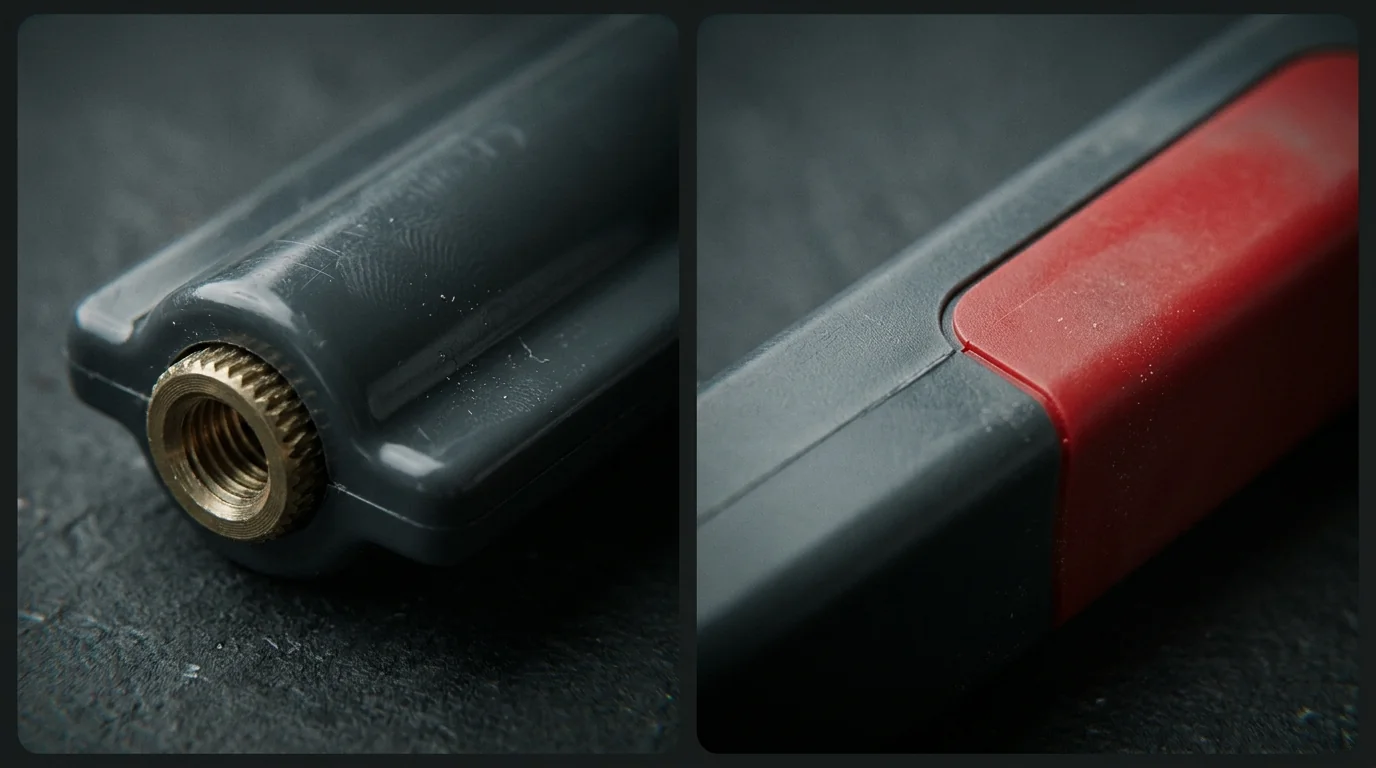
The most widespread pairing combines a rigid plastic with a soft thermoplastic elastomer to obtain the soft-touch surfaces of grips and buttons. The reference pair is TPE over polypropylene: they adhere well to each other through chemical affinity and give a solid bond without adhesives. Other pairings combine two rigid engineering polymers with different characteristics, or mould plastic over a metal insert, as in connectors that must stay firm over time.
The crux is compatibility. Not all materials bond: the substrate and overmoulded pair is the first thing to check, because the part’s integrity depends on it. When chemical adhesion is not enough, the bond is achieved mechanically, by designing undercuts, through-holes or slots into which the second material flows and anchors once cooled.
| Substrate (rigid) | Overmoulded | Type of bond | Typical use |
|---|---|---|---|
Polypropylene (PP) | TPE / TPV | chemical | grips, caps, soft-touch seals |
ABS | TPE / TPU | chemical, sometimes mechanical | consumer electronics, housings |
Polycarbonate (PC) | TPU | chemical | devices, contact parts |
Polyamide (PA) | PA-based TPE | chemical | technical parts, automotive |
PBT | dedicated TPE | chemical | connectors, electrical components |
Metal insert | PA, PBT, PP | mechanical | terminals, connections, threaded parts |
Choosing the material and checking compatibility are part of the work we do at the start, together with the mould design. That is where it is decided whether a pairing holds up.
Indicative pairings, to be confirmed case by case and with FPM depending on the part.
Benefits and applications
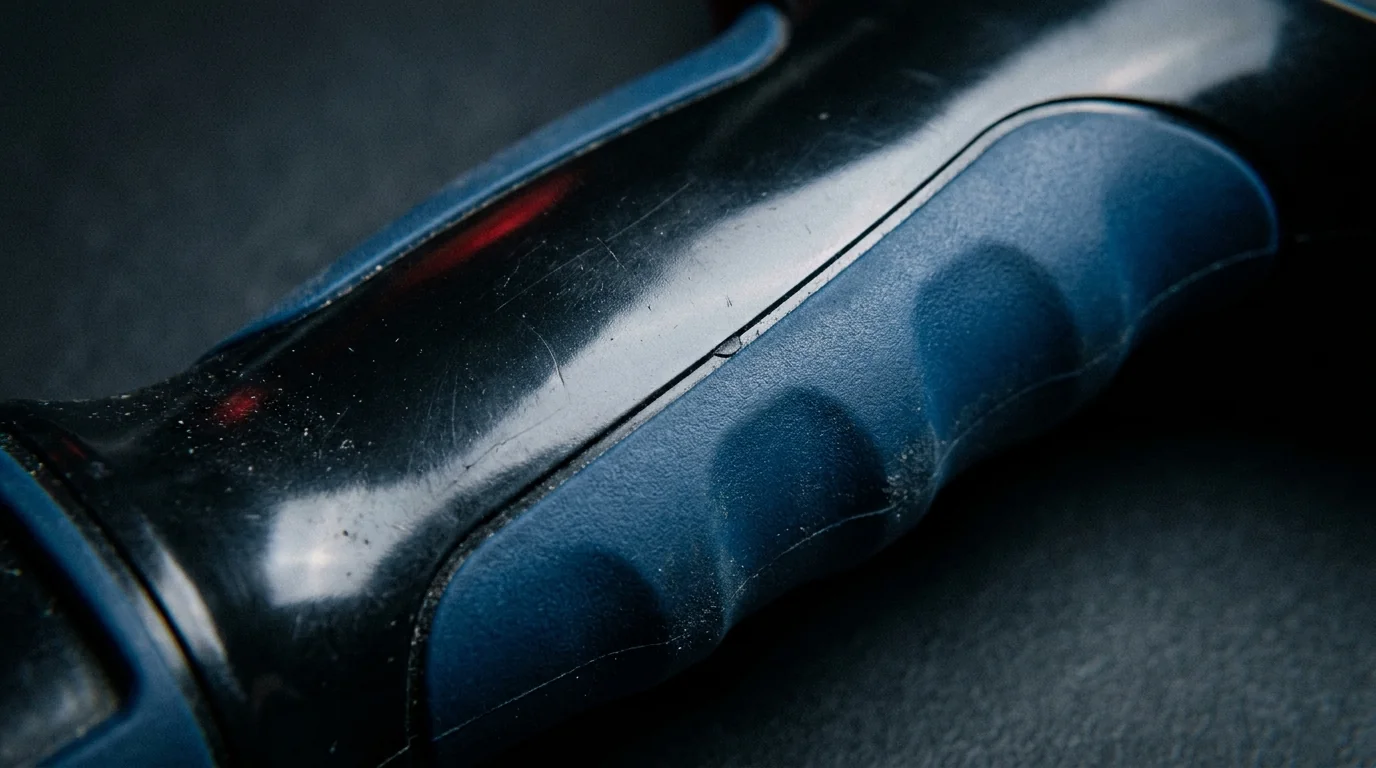
The most concrete benefit of overmoulding is that it removes an assembly step. What would otherwise be two parts to join comes out of the mould already complete: lower assembly costs, fewer components in stock, a better seal at critical points and an aesthetic result that is hard to achieve any other way. A soft-touch surface makes the object more ergonomic; an overmoulded seal holds better than one fitted separately; a metal insert embedded in the plastic stays in place without screws.
You find it in a great many products: grips of tools and power tools, toothbrushes, knobs, buttons and keys, connectors and cabling, seals and sealing parts, automotive components and medical devices. Whenever a rigid and a soft material are needed in the same part, or plastic firmly bonded to metal, overmoulding is often the cleanest answer.
It all starts with the mould
A successful overmoulding depends above all on the mould and the design. You have to study how the substrate is positioned, how the second material wraps around it, where chemical adhesion is needed and where mechanical anchoring is preferable, how to manage the two different shrinkages without warping the part, where to place the gates for the second stage. These are decisions taken on the mould drawing, months before the first part.
This is where our experience comes in. We design and build the plastic injection mould and assess the component’s feasibility with you, from the drawing to the choice of materials and the substrate-overmould pairing. We tell you honestly whether the part holds up, which of insert moulding and 2K suits your volumes and how to get there with a well-made mould.
If you have a product idea that puts two materials in a single part, bring it to us: we work out together whether overmoulding is the right route and how best to achieve it.
Have a multi-material part in mind? Tell us about your project.
The sectors we work in
The moulds we build take shape in components for very different sectors, each with its own needs: functional and ergonomic parts for automotive, technical parts with tight tolerances for electronics, components where hygiene and reliability matter for medical, soft-touch finishes for home appliances and household goods.
Do you have a part that requires two materials? Let’s assess overmoulding together.
Frequently asked questions about overmoulding
What is injection overmoulding?
It is a multi-step injection moulding process in which two or more materials are moulded one over the other. First a rigid substrate is moulded, then a second material, usually a soft elastomer, is injected over it. The bond sets on cooling and gives a single multi-material part.
What is the difference between overmoulding and 2K moulding?
They are two ways of achieving the same result. In insert moulding the substrate is moulded separately and then loaded into the mould for the second injection; in 2K the two injections take place in the same press, in a single automatic cycle. 2K is more efficient at high volumes, insert moulding more flexible and suited to metal inserts.
What is the difference between overmoulding and insert moulding?
Insert moulding is a form of overmoulding in which a ready-made insert, often metal, is loaded into the mould and overmoulded with plastic. In classic overmoulding, instead, the substrate is a previously moulded plastic part. What changes is the nature of the first element, not the principle.
Which materials are used in overmoulding?
Often a rigid plastic paired with a soft thermoplastic elastomer (TPE) for soft-touch surfaces, but also two rigid engineering polymers or plastic over a metal insert. The most common pair is TPE over polypropylene. The compatibility between substrate and overmoulded material must always be checked first.
Does TPE bond to polypropylene?
Yes, TPE and polypropylene are one of the most used pairs in overmoulding, because they adhere well through chemical affinity without the need for adhesives. There are TPE grades formulated specifically to bond to PP, PA, PC and other substrates. Where chemical adhesion is not enough, mechanical anchoring is added.
What is overmoulding used for?
It serves to obtain in a single part what would otherwise require several components and an assembly step: soft-touch grips, sealing gaskets, buttons, connectors with inserts. It reduces assembly costs, improves ergonomics and sealing and gives an aesthetic result that is hard to achieve otherwise.
When is 2K better than insert moulding?
2K pays off at high volumes, where the single automatic cycle cuts times and cost per part, in exchange for a higher initial investment in mould and press. Insert moulding pays off at medium volumes, when there are metal inserts or when you want to contain the cost of the tooling.
Does FPM carry out overmoulding?
FPM designs and builds the overmoulding mould and assesses the component’s feasibility with you, from the geometry to the choice and compatibility of the materials. Bring us the project and we’ll work out the best solution together, from insert moulding to 2K two-shot moulding.