Plastic moulding is the process that, using a mould, heat and pressure, turns polymers into finished components. The most widespread technique is injection moulding: the granules are melted and injected at high pressure into a closed mould, where they cool and solidify before ejection. FPM has been doing this on a contract basis for over 40 years in Lodrino, in the province of Brescia, building the mould in-house as well.
Contract plastic injection moulding, for over 40 years
Do you need a partner that produces your plastic components consistently, part after part, without you having to chase suppliers? FPM has been handling contract plastic injection moulding for over 40 years, at its site in Lodrino, in the province of Brescia.
Our advantage is simple: we build the mould ourselves and then mould the part, right through to finishing. A single point of contact from your idea to the component ready for assembly, with quality verified by ISO 9001:2015 certification.
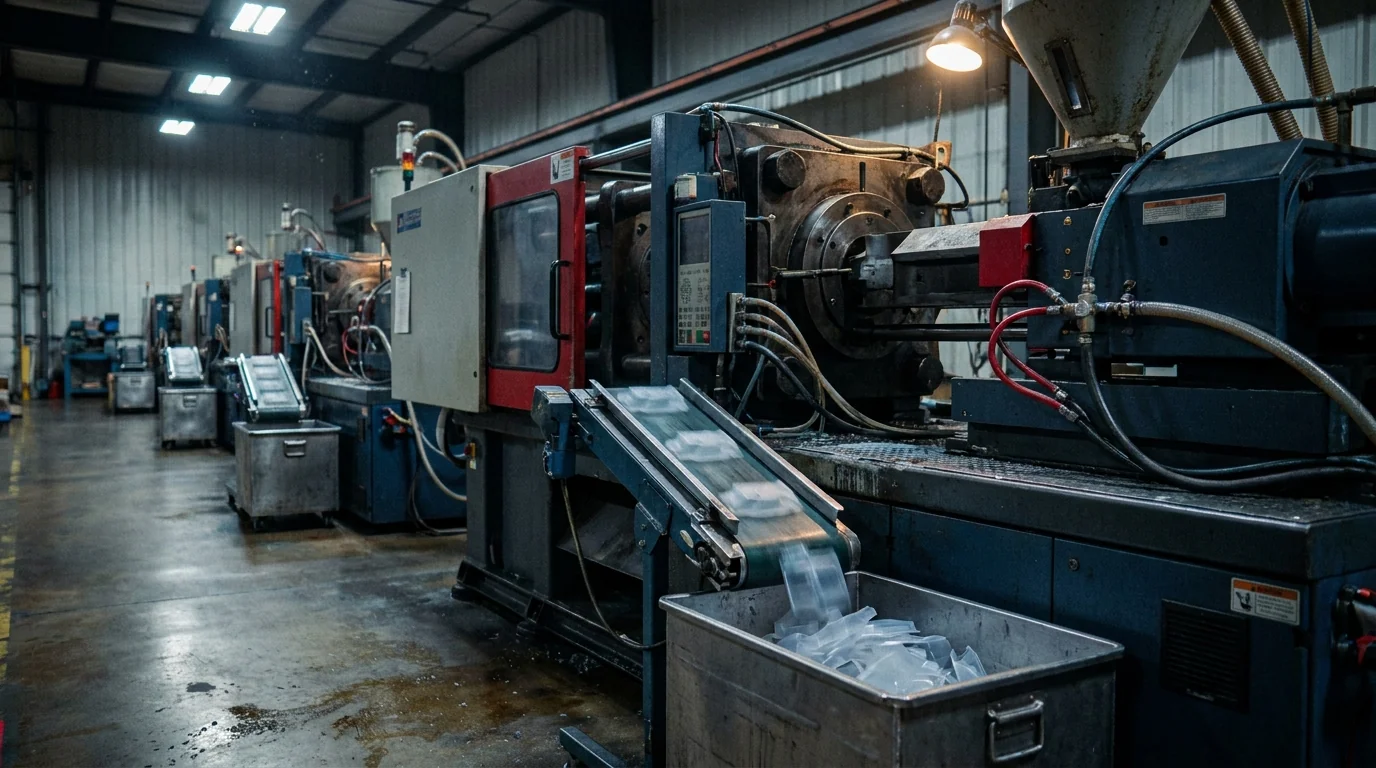
Why entrust the moulding of your components to FPM
When you entrust a production run to us you don’t just buy moulded parts: you get a single supplier that follows the whole path, from the mould to the finished product. Here is what changes for you:
- Mould and moulding in the same company. We build the plastic injection mould in-house and then mould your components: if a tweak is needed in production, we do it ourselves, with no back-and-forth between suppliers.
- Contract work, including small and medium runs. We adapt to your volumes, from pilot batches to recurring production.
- Quality checked on every batch, with ISO 9001:2015 certification and over 40 years of experience in plastics and die-casting.
- Close to you, in Lombardy. Our site is in Lodrino, in the province of Brescia: shorter distances and more control over deliveries.
- We complete the part with assembly, pad printing and finishing, right through to volume supply.
Want to have your plastic components produced? Tell us about your project.
What plastic moulding is
Moulding is the set of techniques that give shape to a plastic material using a mould. The principle is always the same: the polymer is brought to a fluid or plastic state with heat, forced into the mould cavity, allowed to solidify, and the part is ejected with the required geometry.
Materials fall into two broad families. Thermoplastics (such as PP, ABS, polyamide, polycarbonate) soften with heat and turn solid again on cooling: this cycle can be repeated, so they can be reprocessed and recycled, and this is the family we work with in injection moulding. Thermosets cross-link irreversibly during forming and, once solidified, do not become fluid again.
There is a second distinction that weighs heavily on the result, and that almost no one explains: the molecular structure. Amorphous polymers (ABS, PC, PS, PMMA) have disordered chains, shrink little, generally below 0.8%, and stay dimensionally stable. Semi-crystalline polymers (PP, PE, PA, POM, PBT) have ordered regions that compact as they cool: they shrink more, even over 2%, and tend to warp if cooling is not uniform. Knowing which family your material belongs to lets us predict shrinkage, tolerances and warping risk right from the mould design stage.
How it works: the injection moulding cycle in 4 stages
Injection moulding works in cycles, always identical, even thousands of times a day. Each cycle goes through four stages.
01 Plasticising
The granules drop from the hopper into the press barrel, where a rotating screw draws them forward. The friction of the screw and the barrel’s heater bands bring the polymer to a molten, homogeneous state. A slight back pressure helps mix the material and drive out the air.
02 Injection
With the mould closed, the screw moves forward like a piston and pushes the melt into the cavity at high speed. Injection pressure can exceed 2,000 bar. When the cavity is almost full, the process switches from the injection phase to the holding phase.
03 Holding and cooling
A holding pressure keeps pushing material into the cavity while the part cools, to compensate for shrinkage and keep dimensions stable. The heat is removed by the temperature-control channels, usually water-fed, machined into the mould. It is the longest phase of the cycle: on many parts it accounts for over half of the total time.
04 Ejection
Once the part has solidified the mould opens and the ejectors, sometimes helped by a robot, release the component. Then the mould closes again and the cycle restarts.
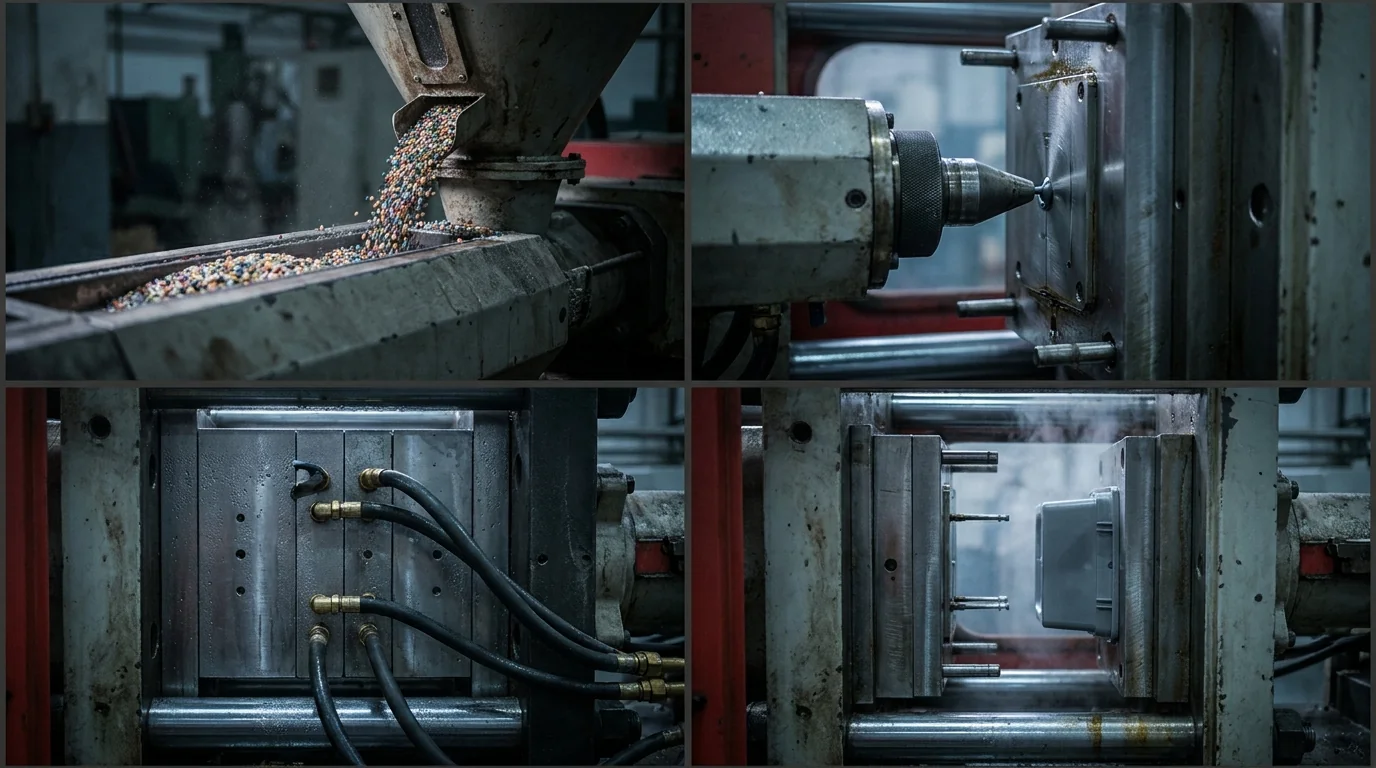
The consistency of these stages is what sets a reliable production run apart: melt temperature, pressures, speeds and cooling times must be kept under control on every batch so that each part comes out the same as the last. If you want to go into the technical detail of the process and parameters, we cover it on the page dedicated to injection moulding.
Moulding techniques and when to choose them
There is no single moulding technique: the choice depends on volumes, part geometry and material. We work with injection moulding, the go-to solution for precision technical components in series. We know the other techniques and will explain them to you, because when we quote we tell you honestly whether injection really is the right route for your part or whether another process would suit you better.
| Technique | How it works | Typical materials | Ideal volumes | Geometries | Examples |
|---|---|---|---|---|---|
Injection moulding | melt injected at high pressure into a closed mould | thermoplastics (PP, ABS, PA, PC, POM) | medium and high | complex, thin-walled | technical components, housings |
Compression moulding | material pressed in an open, heated mould | thermosets, rubbers | low and medium | robust, simple | electrical parts, handles |
Thermoforming | heated sheet formed with vacuum or pressure | thermoplastic sheets | low and medium | shells, trays | packaging, panels |
Blow moulding | preform inflated with air against the mould | thermoplastics (PE, PET) | high | hollow bodies | bottles, tanks |
Rotational moulding | powder melted in a rotating mould | PE powders | low | large hollow bodies | tanks, containers |
Gas-assisted injection (GAIM) | inert gas creates hollow channels in the part | thermoplastics | medium and high | thick or ribbed parts | handles, structural parts |
Overmoulding | a second material moulded over a first | rigid + elastomer (TPE) | medium | multi-material | soft-touch grips, seals |
For technical components in series, injection remains the reference choice because it combines precision, repeatability and low cost per part as volumes rise. If your item calls for overmoulding or gas-assisted injection, we discuss it at the feasibility stage.
The presses we use for moulding
The heart of moulding is the injection press, made up of two units: the injection unit, which melts and pushes the material, and the clamping unit, which holds the mould closed against the thrust of the melt. The clamping force, expressed in tonnes, is the parameter that decides which press your part needs: it must exceed the thrust the material exerts on the mould walls, that is the cavity pressure multiplied by the projected area of the part. This is why a large, thin part can require more tonnage than a small, thick one.
Presses differ in how they move these units:
- Hydraulic. They use hydraulic pumps and actuators. They are robust and handle high pressures and large parts well, but consume more and need more maintenance.
- Electric. All movements are driven by electric motors. They are precise, repeatable and energy-efficient, at a higher initial cost.
- Hybrid. They combine electric motors for injection with hydraulic actuators for clamping: a compromise between efficiency and high clamping force.
When we quote we choose the tonnage and press type best suited to your part and volumes.
The materials we mould
We work with a wide range of thermoplastic polymers, from the most common ones to high-performance engineering polymers, including glass-fibre filled grades for the most demanding applications. We choose the material with you based on the component’s mechanical, aesthetic, thermal and chemical performance.
Every polymer has its own processing window and its own cooling behaviour. Three things matter most: the temperature the melt has to reach, the shrinkage with which it contracts as it solidifies, on which the mould dimensions depend, and the hygroscopicity, that is how much moisture it absorbs. Hygroscopic materials such as polyamide, polycarbonate, ABS, PBT and PET must be dried before moulding, otherwise the water in the granules causes bubbles, streaks and drops in strength on the finished part.
| Polymer | Code | Structure | Melt temperature | Mould temperature | Shrinkage | Drying | Typical uses |
|---|---|---|---|---|---|---|---|
Polypropylene | PP | semi-crystalline | 200-260 °C | 20-60 °C | 1.2-2.5% | not required | containers, car parts, household goods |
Polyethylene | PE (HDPE) | semi-crystalline | 180-260 °C | 20-60 °C | 1.5-3.0% | not required | caps, bottles, packaging |
ABS | ABS | amorphous | 210-260 °C | 40-80 °C | 0.4-0.8% | required | housings, cosmetic parts |
Polystyrene | PS | amorphous | 180-260 °C | 20-60 °C | 0.4-0.7% | not required | technical items, packaging |
Polycarbonate | PC | amorphous | 280-320 °C | 80-120 °C | 0.6-0.8% | required | transparent and technical parts |
PMMA | PMMA | amorphous | 220-260 °C | 40-80 °C | 0.3-0.8% | required | optics, transparent parts |
Polyamide 6 | PA6 | semi-crystalline | 230-290 °C | 40-90 °C | 0.8-1.5% | required | gears, mechanical parts |
Polyamide 6.6 | PA66 | semi-crystalline | 260-300 °C | 40-90 °C | 1.0-2.0% | required | under-the-bonnet parts |
POM | POM | semi-crystalline | 190-220 °C | 60-100 °C | 1.8-2.5% | light | friction and precision parts |
PBT | PBT | semi-crystalline | 240-270 °C | 40-80 °C | 1.5-2.2% | required | connectors, electrical parts |
PET | PET | semi-crystalline | 260-290 °C | 80-120 °C | 1.2-2.0% | required | preforms, technical parts |
Among the special materials we process glass-filled polyamides and Ixef polyarylamide, for parts that need high stiffness and dimensional stability.
Indicative process values, to be confirmed with FPM.
Moulding defects and how we keep them under control
Good moulding shows in the parts that don’t come back. Most defects arise from a mismatch between part geometry, mould and press parameters. Working the mould in-house too gives us an edge: when a defect originates from the tooling, we act directly, without going through third parties. Here are the most common defects, where they come from and how we prevent them.
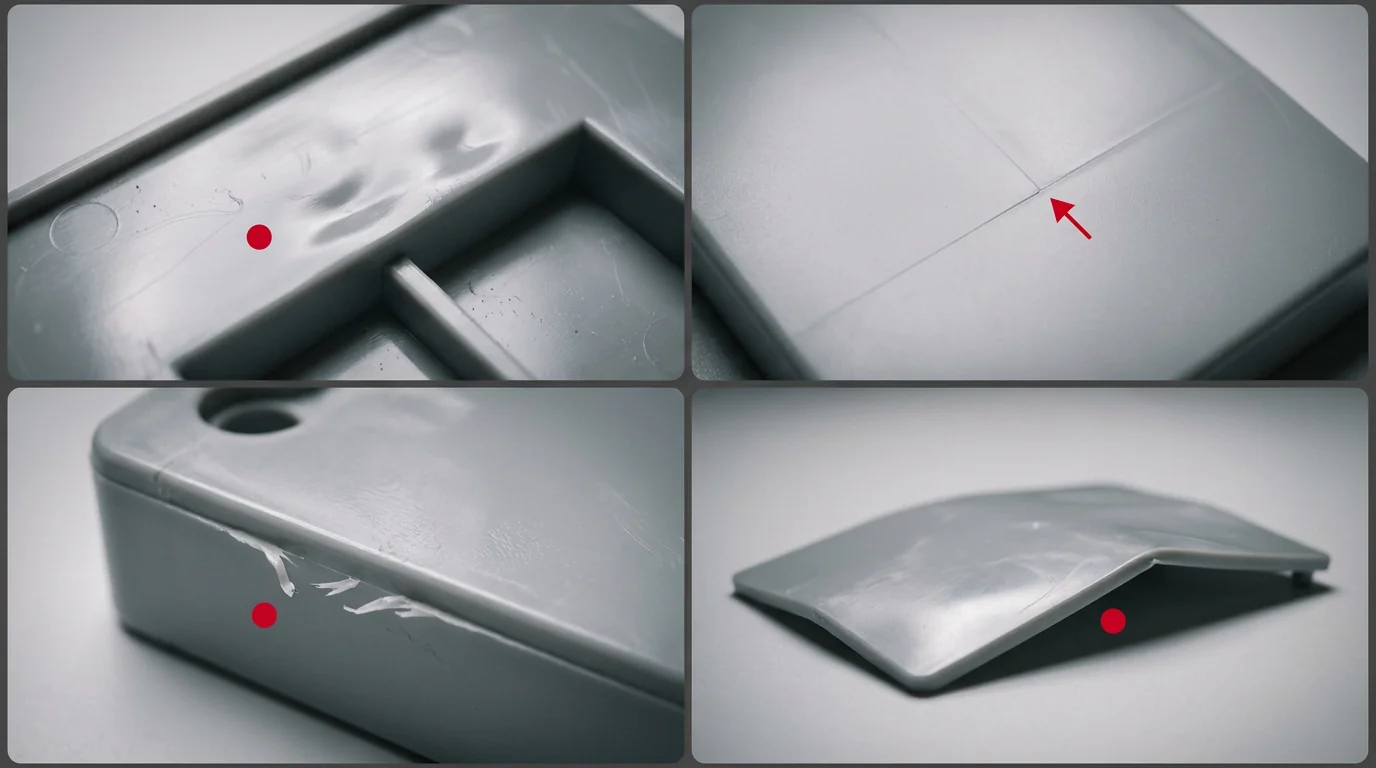
- Sink marks. Surface depressions where the part is thicker, for example above a rib. They arise from non-uniform wall thickness, holding pressure or time that is too low, or uneven cooling. They are prevented by evening out wall thickness at the design stage, coring out heavy sections and tuning the holding phase properly.
- Weld lines. They form where two material fronts meet again, for example around a hole, and do not weld well. They depend on gate position and on a temperature that is too low. They are reduced by moving the gate, adding vents and raising temperatures.
- Flash. Excess material along the mould parting line. It comes from excessive pressure, insufficient clamping force or a worn mould. It is solved with the right parameters, a press of adequate tonnage and mould maintenance.
- Flow lines. Streaks left by the flowing material. They depend on injection speed and non-uniform temperatures. They are corrected by adjusting speed and temperature control and reviewing the gate position.
- Warping. The part comes out twisted or bowed. The most frequent cause is uneven cooling combined with the differential shrinkage of semi-crystalline materials. It is prevented with balanced cooling and a geometry that shrinks evenly.
- Short shots. The cavity does not fill completely. It arises from insufficient shot size or pressure, clogged vents or material that is too cold. It is solved by increasing shot size and pressure and improving the vents.
- Burn marks. Dark spots caused by trapped air which, as it is compressed, burns the material, the so-called diesel effect. They are eliminated by improving the vents and reducing injection speed at the critical point.
The full troubleshooting, parameter by parameter, is covered in depth on the injection moulding page. We know these defects because we deal with them every day, and we close out most of them already at the mould stage, before they become a production problem.
From mould to finished part: the complete cycle at FPM
This is where we make the difference compared with those who only mould. At FPM you find every stage under one roof:
- Construction of the mould to measure, with in-house co-design and design.
- Moulding of the components on a contract basis.
- Finishing, pad printing and assembly to deliver the part ready for assembly.
This means shorter lead times, fewer suppliers to coordinate and a single person responsible for the result, from the first drawing to volume supply. If a defect that originates from the mould emerges during testing, we fix it on the tooling ourselves.
How contract moulding works with us
Entrusting a contract production run to us means giving us your project and getting the finished parts back, without having to invest in a mould, presses and staff. The path is straightforward.
01 Feasibility and quote
You send us the drawing or sample of the component and the volumes. We study feasibility, choose the material, number of cavities and type of mould, and give you a clear quote on costs and lead times.
02 Mould and sampling
We build the mould, trial it on the press and sample the first parts to check dimensions. If you already have a mould, we check it and, if needed, fine-tune it.
03 Series production
Once production is under way, we keep the parameters constant batch after batch, with material traceability and quality control.
04 Finishing and delivery
Where included, we complete with finishing, pad printing and assembly, then pack as agreed and deliver on the set schedule.
Quality control and repeatability
Good moulding shows in the parts that don’t come back. We check the components’ dimensions and keep the press parameters under control on every batch, so that production stays consistent from the first to the last part. ISO 9001:2015 certification frames all of this within traceable procedures, so you always know how your batch was produced.
When the component requires it, we carry out more thorough dimensional checks and agree the incoming inspections with you. The goal is a single one: that the parts arrive compliant and that you don’t have to redo the checks at your end.
The sectors we work in
Over the years we have moulded components for very different sectors, each with its own needs: mechanical and functional parts for automotive, technical parts with tight tolerances for electronics and home appliances, components where hygiene and precision matter for medical. We mould for those who can’t afford an out-of-tolerance part:
Do you have plastic components to produce? From the mould to the finishing, we take care of it.
Frequently asked questions about plastic moulding
What are the main plastic moulding techniques?
The main ones are injection moulding, compression moulding, thermoforming, blow moulding and rotational moulding. The choice depends on production volumes, part geometry and the type of polymer.
What is the difference between injection and compression moulding?
Injection melts the granules and injects them at high pressure into the mould: it suits high volumes and complex geometries. Compression presses the material in an open, heated mould: it is used for thermosets and for low or medium runs.
What is plastic injection moulding?
It is the process by which a molten polymer is injected under pressure into a mould, where it cools and solidifies taking the shape of the component. It is the most widely used technique for producing plastic parts in series with precision and repeatability.
Which plastic materials do you mould?
Most thermoplastics, from PP, PE, ABS, PC, PA, POM and PBT to high-performance engineering polymers, including filled grades. We choose the material based on the performance the part requires.
Why do some materials need drying before moulding?
Because hygroscopic polymers such as polyamide, polycarbonate, ABS, PBT and PET absorb moisture from the air. If they are not dried, the water in the granules causes bubbles, streaks and a loss of mechanical strength on the finished part.
What are the most common injection moulding defects?
The most frequent are sink marks, weld lines, flash, flow lines, warping and short shots. They almost always arise from the part geometry, the mould or the parameter set-up, and that is where they are prevented.
What does contract moulding mean?
It means entrusting the production of plastic components to an external company to your specification. It gives you access to the mould, presses and expertise without having to invest in machinery and staff.
What is the difference between a mould and moulding?
The mould is the tool that shapes the part; moulding is the process that produces the part by injecting the material into the mould. FPM handles both.
Where is FPM located?
In Lodrino, in the province of Brescia, in Lombardy. We work with companies throughout Italy.