A thermoplastic injection mould is the steel or aluminium tooling that shapes a plastic component: the polymer granules are melted and injected at high pressure into the mould cavity, where they cool and solidify taking their final geometry. Unlike thermosets, thermoplastics can be remelted and recycled several times. FPM has designed and built custom thermoplastic moulds for over 40 years in Lodrino, in the province of Brescia.
Custom thermoplastic moulds, for over 40 years
Do you have a plastic component to bring into production and are you looking for someone to build the right mould, not a cut-price quote? FPM has designed and built custom thermoplastic moulds for over 40 years, in Lodrino, in the province of Brescia, with ISO 9001:2015 certification.
We make moulds for presses up to 1200 tonnes, from small parts with metal inserts to complex thin-walled geometries, and we follow the project from feasibility through to the sampling of the first parts.
What a thermoplastic is
A thermoplastic is a polymer that softens when heated and turns solid again on cooling, and this cycle can be repeated many times without an irreversible chemical change. The reason lies in the molecular structure: the chains are linear or branched, not stably bonded to each other, so they slide over one another when heat arrives and lock again when the material cools. It is precisely this reversibility that makes thermoplastics suitable for injection moulding in series and makes them recyclable.
Thermoplastics are in turn divided into two groups that change how they behave in the mould. Amorphous polymers (ABS, PC, PS, PMMA) have disordered chains, shrink little and stay dimensionally stable. Semi-crystalline polymers (PP, PE, PA, POM, PBT) have ordered regions that compact as they cool: they shrink more and tend to warp if cooling is not uniform. Knowing which group your material belongs to helps to size the mould cavity correctly and to predict shrinkage and tolerances right from the design stage.
Thermoplastics and thermosets: the difference
The question comes up often, because it decides which type of mould is needed. There is only one difference, but it changes everything: thermoplastics can be remelted, thermosets cannot.
A thermoplastic melts with heat and resolidifies on cooling, endlessly, with no permanent chemical reactions. This is why it is injection moulded, it is recyclable and it covers the vast majority of technical and cosmetic plastic components. A thermoset (phenolic, epoxy, melamine resins, some rubbers) cross-links irreversibly during forming: the chains bond to each other and the material, once solidified, no longer becomes fluid. It resists heat and continuous load better, but it cannot be remelted or recycled by remelting, and it is worked mainly by compression or transfer moulding.
| Feature | Thermoplastics | Thermosets |
|---|---|---|
Behaviour under heat | soften and remelt | cross-link, do not remelt |
Molecular structure | linear or branched chains | three-dimensional network |
Recyclable by remelting | yes | no |
Typical moulding technique | injection | compression, transfer |
High-temperature resistance | medium to high | generally high |
Examples | PP, ABS, PC, PA, POM, PBT | phenolic, epoxy, melamine resins |
We build moulds for the thermoplastic family, the injection-moulding one. It is the field where mould design, steel choice and shrinkage management really make the difference on the finished part.
How thermoplastic injection moulding works
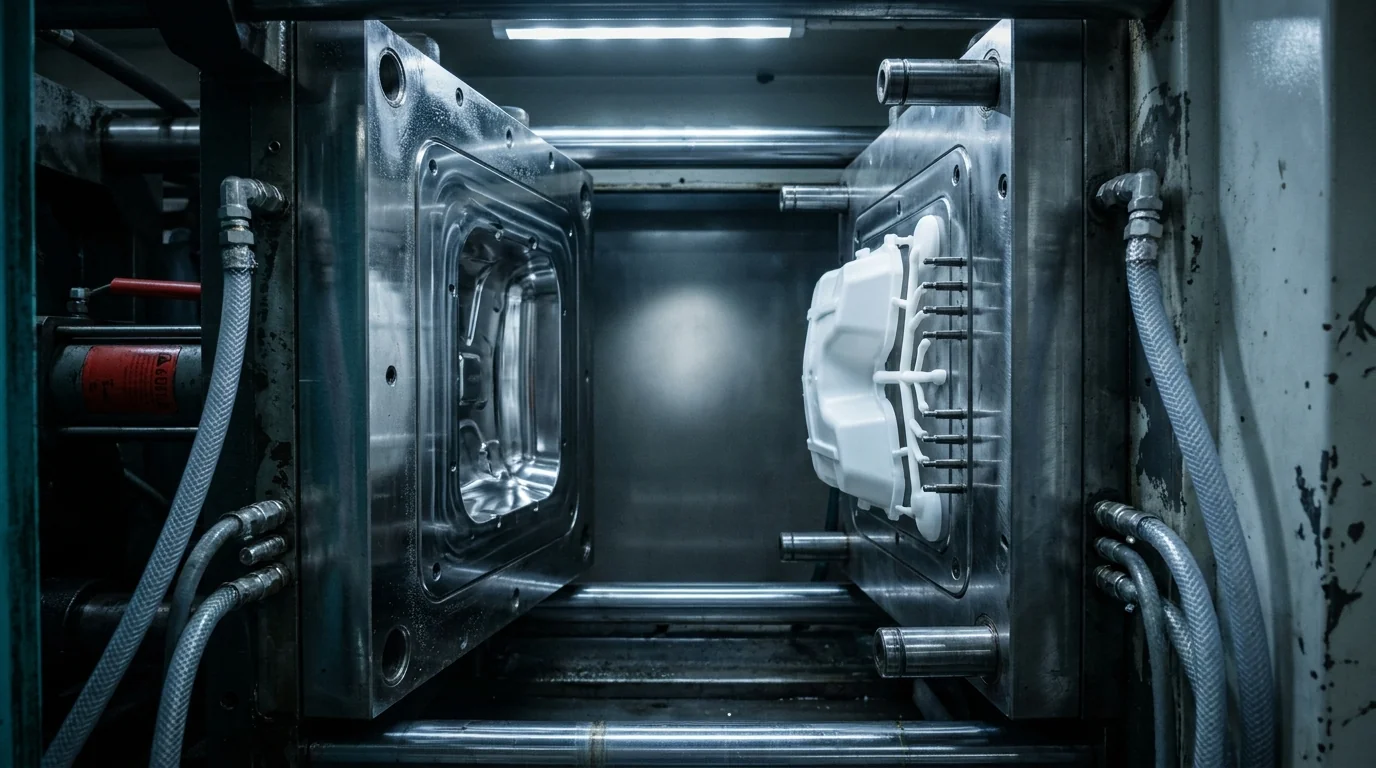
Injection moulding works in identical cycles, repeated even thousands of times a day. The polymer granules drop from the hopper into the press barrel, where a rotating screw draws them forward: friction and the heater bands bring the material to a molten state. With the mould closed the screw moves forward like a piston and pushes the melt into the cavity at high pressure, which can exceed 2,000 bar. A holding pressure compensates for shrinkage while the part cools, then the ejectors release it and the mould closes again for the next cycle.
The mould is the heart of all this. It must withstand the injection pressure, cool the part evenly through the temperature-control channels, open and eject the component without damaging it, and hold the dimensions batch after batch. A defect on the part, from sink marks to warping, often originates in the mould before the press. This is why building it well counts more than any subsequent tuning. We cover how the process works in detail on the page dedicated to injection moulding.
The engineering polymers we work with
We work with the entire range of thermoplastics, from common plastics to high-performance engineering polymers, including glass-fibre filled grades for the most demanding applications. Every polymer has its own processing temperature, its own shrinkage and its own cooling behaviour, and the dimensions to give the mould cavity depend on these. Choosing it well, already at the feasibility stage, avoids problems that would otherwise emerge only during sampling.
| Code | Name | Main properties | Typical applications |
|---|---|---|---|
PP | Polypropylene | lightweight, flexible, good chemical resistance, low cost | containers, car parts, household goods |
PA6 / PA66 | Polyamide (nylon) | tough, wear- and heat-resistant, often glass-filled | gears, mechanical parts, under-the-bonnet |
ABS | Acrylonitrile butadiene styrene | rigid, good cosmetic finish, easy to paint | housings, cosmetic parts, appliances |
PC | Polycarbonate | transparent, high impact, temperature-stable | transparent parts, screens, technical components |
POM | Polyoxymethylene (acetal) | low friction, rigidity, dimensional stability | gears, precision and sliding parts |
PBT | Polybutylene terephthalate | insulating, heat-stable, good rigidity | connectors and electrical components |
PMMA | Polymethyl methacrylate | optical transparency, UV resistance | optics, transparent parts, lighting |
PEI | Polyetherimide | high temperatures, self-extinguishing, rigidity | aerospace, electronics, technical parts |
PPS | Polyphenylene sulphide | high chemical and thermal resistance | under-the-bonnet parts, pumps, electronics |
PPO | Polyphenylene oxide | dimensional stability, insulation, low water absorption | electrical parts, fluid handling |
Ixef | Polyarylamide | high rigidity and surface finish, excellent with glass fill | precision and visible technical components |
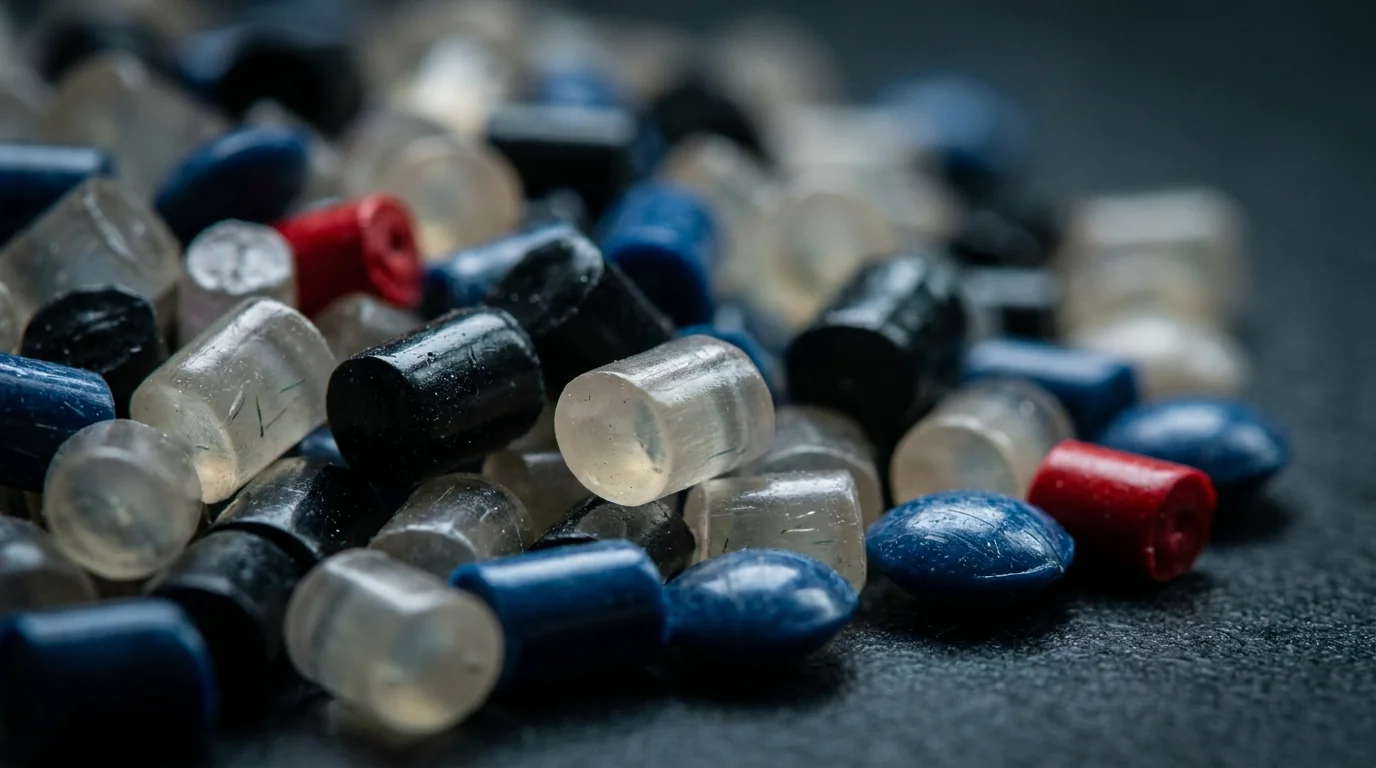
Among the special materials we process glass-filled polyamides and Ixef polyarylamide, for parts that need above-average rigidity and dimensional stability. We choose the material with you based on the mechanical, thermal, chemical and aesthetic performance the component must have.
Steel or aluminium: what a thermoplastic mould is made of
A thermoplastic mould is almost always built from steel, because it has to last over time and hold its dimensions for hundreds of thousands of shots. The steel is chosen according to its role: pre-hardened or quenched-and-tempered steels for the mould bases and plates, hardenable steels for the moulding surfaces subject to wear, stainless steels where corrosion resistance and a cosmetic finish are needed, for example with polymers that release aggressive gases or for visible parts.
Aluminium comes into play above all for prototype moulds and short runs: it is quicker to machine, costs less and cools rapidly, but it wears sooner and does not withstand high volumes. At the feasibility stage we tell you honestly which solution suits your numbers, without selling you a premium steel where a simpler choice will do.
The stages in building a thermoplastic mould
Building a thermoplastic mould is not a single step but a path, and at FPM we manage it in-house stage by stage. Each stage has its own in-depth page, because it goes into technical details that deserve the space.
- Feasibility study. We analyse the part drawing, material, undercuts and critical points, and define the number of cavities, the type of mould, costs and lead times.
- Reverse engineering. When you start from a physical sample rather than a drawing, we survey it and rebuild the 3D CAD model from which to design the mould.
- Prototyping. We make prototypes of the component to validate form, function and assembly before investing in the definitive mould.
- Design and co-design. We design the mould in CAD, working with you on the mouldability of the part: wall thickness, draft, gate positions.
- Injection simulation. We simulate the filling of the cavity to predict weld lines, sink marks and warping, and correct them before cutting the steel.
- Sampling. We trial the mould on the press and produce the first parts, checking the dimensions and fine-tuning the parameters.
- Mould construction. Machining, EDM, assembly and finishing of the moulding surfaces: the mould takes shape right through to delivery.
Having all these stages under one roof means shorter lead times, fewer suppliers to coordinate and a single point of contact responsible for the result, from the first drawing to a tested mould.
Designing a part with the mould in mind
Many moulding problems are avoided at the design table, before the mould is even built. When you bring us a drawing we look at a few things that affect the result and the cost of the tooling:
- Uniform wall thickness. Walls of constant thickness reduce sink marks and warping; heavy sections should be cored out or ribbed.
- Draft angles. Vertical walls need a slight taper to come out of the mould without scoring or getting stuck.
- Undercuts. Undercut geometries require extra slides or ejectors, which raise the cost and complexity of the mould: better to know in advance.
- Gates. Where the material enters decides the filling, the position of the weld lines and the final appearance of the part.
- Radii and fillets. Sharp corners concentrate stresses and hinder flow; fillets improve filling and strength.
This design-for-moulding work, known as DFM, we do together with you during mould design and verify it with injection simulation.
The sectors we work in
We build thermoplastic moulds for those who can’t afford an out-of-tolerance part: mechanical and functional parts for automotive, tight-tolerance components for electronics and home appliances, parts where hygiene and precision matter for medical, technical items for aerospace.
Why choose FPM for your thermoplastic moulds
When you entrust a mould to us you don’t just buy a tool: you get a mould maker that follows the part from feasibility to sampling, and that knows the mould because it has been making them for over 40 years.
- Fully in-house cycle, from feasibility to simulation through to construction and sampling, with no back-and-forth between suppliers.
- Presses up to 1200 tonnes for sampling, from small parts with metal inserts to complex geometries.
- Engineering polymers, technical grades included, from glass-filled polyamides to Ixef polyarylamide.
- ISO 9001:2015 quality and over 40 years of experience in plastic and die-casting moulds.
- In Lodrino, in the province of Brescia, at the heart of the Lombardy mould-making district.
If you also need the parts produced, we do that: you find contract plastic injection moulding in the same company, from the mould to the finished component.
Do you have a thermoplastic component to produce? From the feasibility study to a tested mould, we take care of it.
Frequently asked questions about thermoplastic moulds
What is a thermoplastic?
It is a polymer that softens with heat and turns solid again on cooling, and this cycle can be repeated. Thanks to this reversibility, thermoplastics are injection moulded and are recyclable, unlike thermosets.
What is the difference between thermoplastics and thermosets?
Thermoplastics can be remelted and recycled several times; thermosets cross-link irreversibly during forming and, once solidified, do not become fluid again. The former are injection moulded, the latter mainly compression moulded.
Which materials can be moulded with a thermoplastic mould?
The whole thermoplastic family, from common polymers such as PP, ABS, PA, PC and POM to engineering polymers such as PEI, PPS, PPO and Ixef polyarylamide, including glass-fibre filled grades. The choice depends on the performance required of the part.
What is a thermoplastic mould made of?
Almost always steel, chosen according to its role: pre-hardened or quenched-and-tempered for the plates, hardenable for the moulding surfaces subject to wear, stainless where finish and corrosion resistance are needed. Aluminium is used for prototypes and short runs.
How is an injection mould built?
Through a seven-stage path: feasibility study, reverse engineering, prototyping, design and co-design, injection simulation, sampling and construction. FPM handles them all in-house.
What is DFM in mould design?
It is part design conceived for moulding: uniform wall thickness, draft angles, management of undercuts and gates. Taking care of it in advance prevents defects and contains the cost of the mould.
How large a mould can you build?
We build thermoplastic moulds for presses up to 1200 tonnes, from small precision parts, including those with metal inserts, to complex geometries of significant size.
Where is FPM located?
In Lodrino, in the province of Brescia, in Lombardy. We work with companies throughout Italy and abroad.